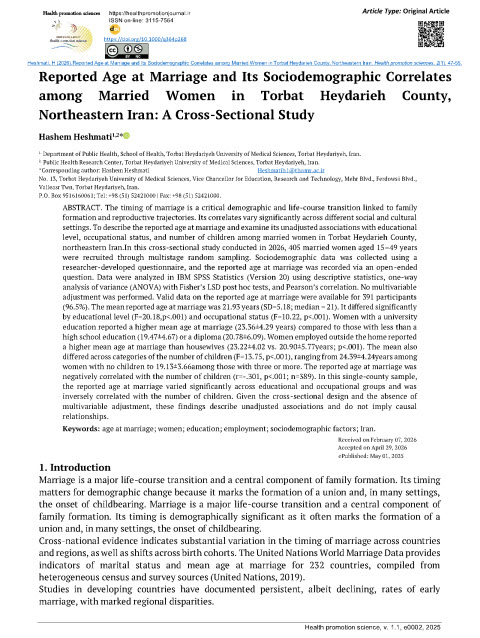
Reported Age at Marriage and Its Sociodemographic Correlates among Married Women in Torbat Heydarieh County, Northeastern Iran
A Cross-Sectional Study of Sociodemographic Correlates and Reporting Patterns
DOI:
https://doi.org/10.1000/q364p268คำสำคัญ:
reported age at marriage; women; education; employment; sociodemographic factors; Iranบทคัดย่อ
The timing of marriage is a critical demographic and life-course transition linked to family formation and reproductive trajectories. Its correlates vary significantly across different social and cultural settings. To describe the reported age at marriage and examine its unadjusted associations with educational level, occupational status, and number of children among married women in Torbat Heydarieh County, northeastern Iran.In this cross-sectional study conducted in 2026, 405 married women aged 15–49 years were recruited through multistage random sampling. Sociodemographic data were collected using a researcher-developed questionnaire, and the reported age at marriage was recorded via an open-ended question. Data were analyzed in IBM SPSS Statistics (Version 20) using descriptive statistics, one-way analysis of variance (ANOVA) with Fisher’s LSD post hoc tests, and Pearson’s correlation. No multivariable adjustment was performed. Valid data on the reported age at marriage were available for 391 participants (96.5%). The mean reported age at marriage was 21.93 years (SD=5.18; median = 21). It differed significantly by educational level (F=20.18,p<.001) and occupational status (F=10.22,p<.001). Women with a university education reported a higher mean age at marriage (23.36±4.29 years) compared to those with less than a high school education (19.47±4.67) or a diploma (20.78±6.09). Women employed outside the home reported a higher mean age at marriage than housewives (23.22±4.02 vs. 20.90±5.77years; p<.001). The mean also differed across categories of the number of children (F=13.75,p<.001), ranging from 24.39±4.24years among women with no children to 19.13±3.66among those with three or more. The reported age at marriage was negatively correlated with the number of children (r=-.301,p<.001; n=389). In this single-county sample, the reported age at marriage varied significantly across educational and occupational groups and was inversely correlated with the number of children. Given the cross-sectional design and the absence of multivariable adjustment, these findings describe unadjusted associations and do not imply causal relationships.
ดาวน์โหลด
การอ้างอิง
1. United Nations, Department of Economic and Social Affairs, Population Division. (2019). World Marriage Data 2019 [Internet]. New York: United Nations. Available from: https://www.un.org/development/desa/pd/data/world-marriage-data/
2. Jensen, R., & Thornton, R. (2003). Early female marriage in the developing world. Gender & Development, 11(2), 9–19. https://doi.org/10.1080/741954311
3. Singh, S., & Samara, R. (1996). Early marriage among women in developing countries. International Family Planning Perspectives, 22(4), 148–157, 175. https://doi.org/10.2307/2950812
4. Caldwell, B. K. (2005). Factors affecting female age at marriage in South Asia: Contrasts between Sri Lanka and Bangladesh. Asian Population Studies, 1(3), 283–301. https://doi.org/10.1080/17441730500441160
5. Torabi, F., & Baschieri, A. (2010). Ethnic differences in transition to first marriage in Iran: The role of marriage market, women’s socio-economic status, and process of development. Demographic Research, 22(2), 29–62. https://doi.org/10.4054/DemRes.2010.22.2
6. Torabi, F., Baschieri, A., Clarke, L., & Abbasi-Shavazi, M. J. (2013). Marriage postponement in Iran: Accounting for socio-economic and cultural change in time and space. Population, Space and Place, 19(3), 258–274. https://doi.org/10.1002/psp.1710
7. Mahdaviazad, H., Malekmakan, L., Sayadi, M., & Tadayon, T. (2019). Trends in age at first marriage in women and related factors: A population-based study in southwestern Iran. Women & Health, 59(2), 171–180. https://doi.org10.1080/03630242.2018.1449777
8. Torabi, F., & Abbasi-Shavazi, M. J. (2016). Women’s education, time use and marriage in Iran. Asian Population Studies, 12(3), 229–250. https://doi.org/10.1080/17441730.2016.1176806
9. Torabi, F., & Bagi, M. (2024). Determinants of early marriage in Iran: A multivariate survivorship analysis using census microdata. International Journal of Adolescence and Youth, 29(1), Article 2312849. https://doi.org/10.1080/02673843.2024.2312849
10. Torabi, F., & Shams-Ghahfarokhi, Z. (2022). Factors affecting marriage delay in Iran and around the world. Journal of Population Association of Iran, 16(32), 141–175. [In Persian]
11. Bongaarts, J., Mensch, B. S., & Blanc, A. K. (2017). Trends in the age at reproductive transitions in the developing world: The role of education. Population Studies, 71(2), 139–154. https://doi.org/10.1080/00324728.2017.1291986
12. Wu, H., & Pesando, L. M. (2025). Demographic convergence in marriage timing: Intersecting gender and educational expansion. Demographic Research, 52(14), 415–444. https://doi.org/10.4054/DemRes.2025.52.14
13. Blossfeld, H. P. (2009). Educational assortative marriage in comparative perspective. Annual Review of Sociology, 35, 513–530. https://doi.org/10.1146/annurev-soc-070308-115913
14. Batyra, E., & Kohler, H. P. (2022). Unequal transitions to adulthood: Widening disparities in age at first union, sex, and birth in many low- and middle-income countries. Studies in Family Planning, 53(3), 549–565. https://doi.org/10.1111/sifp.12211
15. Compernolle, E. L., & Axinn, W. G. (2019). Mass education, international travel, and ideal ages at marriage. Demography, 56(6), 2083–2108. https://doi.org/10.1007/s13524-019-00838-7
16. Nitsche, N., & Hayford, S. R. (2020). Preferences, partners, and parenthood: Linking early fertility desires, marriage timing, and achieved fertility. Demography, 57(6), 1975–2001. https://doi.org/10.1007/s13524-020-00927-y
17. Jensen, R., Romero, M. N., Stocker, A., & Thornton, R. (2026). Five decades of early marriage: A research note from the demographic and health surveys. Journal of Population Research, 43, Article 22. https://doi.org/10.1007/s12546-026-09430-4
18. Parsons, J., Edmeades, J., Kes, A., Petroni, S., Sexton, M., & Wodon, Q. (2015). Economic impacts of child marriage: A review of the literature. The Review of Faith & International Affairs, 13(3), 12–22. https://doi.org/10.1080/15570274.2015.1075757
19. Malhotra, A., & Elnakib, S. (2021). 20 years of the evidence base on what works to prevent child marriage: A systematic review. Journal of Adolescent Health, 68(5), 847–862. https://doi.org/10.1016/j.jadohealth.2020.11.017
20. Plesons, M., Travers, E., Malhotra, A., Finnie, A., Maksud, N., & Chandra-Mouli, V. (2021). Updated research gaps on ending child marriage and supporting married girls for 2020–2030. Reproductive Health, 18, Article 152. https://doi.org/10.1186/s12978-021-01176-x
21. Corno, L., Hildebrandt, N., & Voena, A. (2020). Age of marriage, weather shocks, and the direction of marriage payments. Econometrica, 88(3), 879–915. https://doi.org/10.3982/ECTA15505
22. Field, E., & Ambrus, A. (2008). Early marriage, age of menarche, and female schooling attainment in Bangladesh. Journal of Political Economy, 116(5), 881–930. https://doi.org/10.1086/593333
23. Arthur, M., Earle, A., Raub, A., Vincent, I., Atabay, E., Latz, I., Nandi, A., & Heymann, J. (2018). Child marriage laws around the world: Minimum marriage age, legal exceptions, and gender disparities. Journal of Women, Politics & Policy, 39(1), 51–74. https://doi.org/10.1080/1554477X.2017.1375786
การดาวน์โหลด
ตีพิมพ์แล้ว
ฉบับ
ส่วน
หมวดหมู่
ใบอนุญาต
ลิขสิทธิ์ (c) 2026 Creative Commons Attribution-NonCommercial 4.0 International License

ผลงานนี้ได้รับอนุญาตภายใต้ Creative Commons Attribution-NonCommercial-NoDerivatives 4.0 International License.
This open-access journal is published under the terms of the Creative Commons Attribution-NonCommercial 4.0 International License which permits Share (copy and redistribute the material in any medium or format) and Adapt (remix, transform, and build upon the material) under the Attribution-NonCommercial term
วิธีการอ้างอิง
##plugins.generic.shariff.share##




##plugins.generic.funding.fundingData##
-
Torbat Heydariyeh University of Medical Sciences
##plugins.generic.funding.funderGrants## 402000039