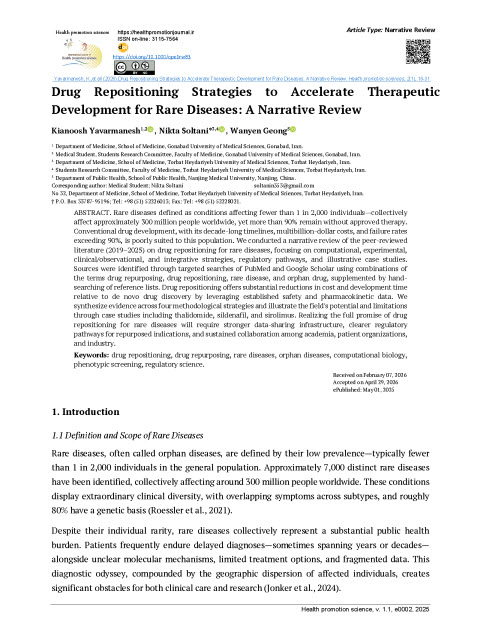
Drug Repositioning Strategies to Accelerate Therapeutic Development for Rare Diseases A Narrative Review
An Overview of Computational, Phenotypic, and Regulatory Approaches
DOI:
https://doi.org/10.1000/qpe1rw83Resumo
Rare diseases defined as conditions affecting fewer than 1 in 2,000 individuals—collectively affect approximately 300 million people worldwide, yet more than 90% remain without approved therapy. Conventional drug development, with its decade-long timelines, multibillion-dollar costs, and failure rates exceeding 90%, is poorly suited to this population. We conducted a narrative review of the peer-reviewed literature (2019–2025) on drug repositioning for rare diseases, focusing on computational, experimental, clinical/observational, and integrative strategies, regulatory pathways, and illustrative case studies. Sources were identified through targeted searches of PubMed and Google Scholar using combinations of the terms drug repurposing, drug repositioning, rare disease, and orphan drug, supplemented by hand-searching of reference lists. Drug repositioning offers substantial reductions in cost and development time relative to de novo drug discovery by leveraging established safety and pharmacokinetic data. We synthesize evidence across four methodological strategies and illustrate the field's potential and limitations through case studies including thalidomide, sildenafil, and sirolimus. Realizing the full promise of drug repositioning for rare diseases will require stronger data-sharing infrastructure, clearer regulatory pathways for repurposed indications, and sustained collaboration among academia, patient organizations, and industry.
Downloads
Referências
Cortial, L., Montero, V., Tourlet, S., Del Bano, J., & Blin, O. (2024). Artificial intelligence in drug repurposing for rare diseases: A mini-review. Frontiers in Medicine, 11, 1404338. https://doi.org/10.3389/fmed.2024.1404338
European Medicines Agency. (2022). EMA pilot on repurposing: Final report on the pilot to gain experience with repurposing of authorised medicines. European Medicines Agency.
Gangwal, A., & Lavecchia, A. (2025). AI-driven drug discovery for rare diseases. Journal of Chemical Information and Modeling, 65(5), 2214–2231. https://doi.org/10.1021/acs.jcim.4c01966
Hay Mele, B., Rossetti, F., Cubellis, M. V., Monticelli, M., & Andreotti, G. (2024). Drug repurposing and lysosomal storage disorders: A trick to treat. Genes, 15(3), 290. https://doi.org/10.3390/genes15030290
Jonker, A. H., Day, S., Gabaldo, M., Stone, H., Kort, M. D., O’Connor, D. J., ... & IRDiRC Drug Repurposing Guidebook Working Group. (2023). IRDiRC drug repurposing guidebook: Making better use of existing drugs to tackle rare diseases. Nature Reviews Drug Discovery, 22(12), 937–938. https://doi.org/10.1038/d41573-023-00168-9
Jonker, A. H., O'Connor, D., Cavaller-Bellaubi, M., Fetro, C., Gogou, M., 't Hoen, P. A. C., de Kort, M., Stone, H., Valentine, N., & Pasmooij, A. M. G. (2024). Drug repurposing for rare: Progress and opportunities for the rare disease community. Frontiers in Medicine, 11, 1352803. https://doi.org/10.3389/fmed.2024.1352803
Kumar, D. (2025). Drug repurposing for rare (orphan) diseases—Scope and limitations. Apollo Medicine, 22(4), 329–335. https://doi.org/10.1177/09760016241287308
Nijim, et al. (2025). Strategies to advance drug repurposing for rare diseases. REPO4EU. (Preprint)
Paquot, A., Deprez, B., & Beghyn, T. (2024). Drug repurposing and phenotypic screening: Innovative strategies for treating ultra-rare disorders. Frontiers in Medicine, 11, 1489094. https://doi.org/10.3389/fmed.2024.1489094
Roessler, H. I., Knoers, N. V. A. M., van Haelst, M. M., & van Haaften, G. (2021). Drug repurposing for rare diseases. Trends in Pharmacological Sciences, 42(4), 255–267. https://doi.org/10.1016/j.tips.2021.01.003
Wei, S., Sasi, C., Piepenbrock, J., Huynen, M. A., & 't Hoen, P. A. C. (2025). The use of knowledge graphs for drug repurposing: From classical machine learning algorithms to graph neural networks. Computers in Biology and Medicine, 196(Part C), 110873. https://doi.org/10.1016/j.compbiomed.2025.110873
Downloads
Publicado
Licença
Direitos de Autor (c) 2026 Creative Commons Attribution-NonCommercial 4.0 International License

Este trabalho encontra-se publicado com a Licença Internacional Creative Commons Atribuição-NãoComercial-SemDerivações 4.0.
This open-access journal is published under the terms of the Creative Commons Attribution-NonCommercial 4.0 International License which permits Share (copy and redistribute the material in any medium or format) and Adapt (remix, transform, and build upon the material) under the Attribution-NonCommercial term
Como Citar
##plugins.generic.shariff.share##