Transformational, Teacher, and Distributed Leadership and Educational Innovation
Implications for Practice and Future Inquiry
DOI:
https://doi.org/10.1000/vbcbmn49چکیده
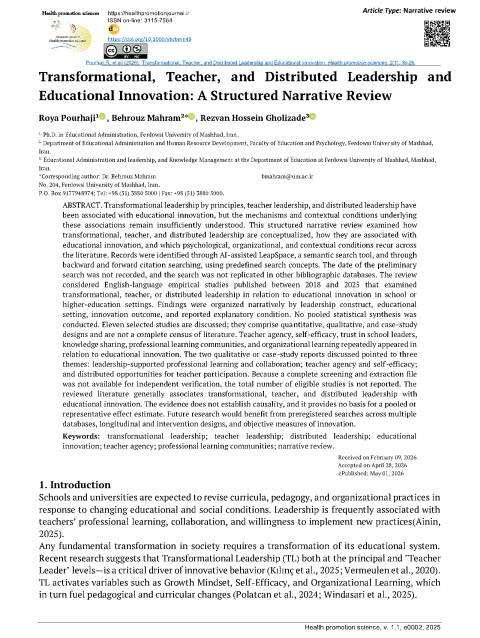
Transformational leadership by principles, teacher leadership, and distributed leadership have been associated with educational innovation, but the mechanisms and contextual conditions underlying these associations remain insufficiently understood. This structured narrative review examined how transformational, teacher, and distributed leadership are conceptualized, how they are associated with educational innovation, and which psychological, organizational, and contextual conditions recur across the literature. Records were identified through AI-assisted LeapSpace, a semantic search tool, and through backward and forward citation searching, using predefined search concepts. The date of the preliminary search was not recorded, and the search was not replicated in other bibliographic databases. The review considered English-language empirical studies published between 2018 and 2025 that examined transformational, teacher, or distributed leadership in relation to educational innovation in school or higher-education settings. Findings were organized narratively by leadership construct, educational setting, innovation outcome, and reported explanatory condition. No pooled statistical synthesis was conducted. Eleven selected studies are discussed; they comprise quantitative, qualitative, and case-study designs and are not a complete census of literature. Teacher agency, self-efficacy, trust in school leaders, knowledge sharing, professional learning communities, and organizational learning repeatedly appeared in relation to educational innovation. The two qualitative or case-study reports discussed pointed to three themes: leadership-supported professional learning and collaboration; teacher agency and self-efficacy; and distributed opportunities for teacher participation. Because a complete screening and extraction file was not available for independent verification, the total number of eligible studies is not reported. The reviewed literature generally associates transformational, teacher, and distributed leadership with educational innovation. The evidence does not establish causality, and it provides no basis for a pooled or representative effect estimate. Future research would benefit from preregistered searches across multiple databases, longitudinal and intervention designs, and objective measures of innovation.
دانلودها
مراجع
Ainin, J., Tampus, M., & Eliseo, J. (2025). Teacher leadership and collaboration in leading curriculum innovation: A case study on effective practices. International Journal of Research in Social Science and Humanities. https://doi.org/10.47505/ijrss.2025.1.7
Bass, B. M. (1985). Leadership and performance beyond expectations. Free Press.
Cao, J., Huang, Y., Shao, X., & Zhong, Y. (2024). Driving innovation: Exploring the effect of distributed leadership on collective teacher innovativeness in Chinese schools. The Asia-Pacific Education Researcher. https://doi.org/10.1007/s40299-024-00866-x
Dedering, K., & Pietsch, M. (2023). School leader trust and collective teacher innovativeness: On individual and organisational ambidexterity’s mediating role. Educational Review, 77, 351–380. https://doi.org/10.1080/00131911.2023.2195593
Gong, J. (2025). The effects of distributed leadership on teaching innovation in Shanghai, China: The mediating roles of teacher autonomy, teacher collaboration, and teacher self-efficacy. Frontiers in Psychology, 16. https://doi.org/10.3389/fpsyg.2025.1562838
Lin, Q. (2022). The relationship between distributed leadership and teacher innovativeness: Mediating roles of teacher autonomy and professional collaboration. Frontiers in Psychology, 13. https://doi.org/10.3389/fpsyg.2022.948152
Luyten, H., & Bazo, M. (2019). Transformational leadership, professional learning communities, teacher learning and learner-centred teaching practices: Evidence on their interrelations in Mozambican primary education. Studies in Educational Evaluation, 60, 14–31. https://doi.org/10.1016/j.stueduc.2018.11.002
Polatcan, M., Özkan, P., & Bellibas, M. (2024). Cultivating teacher innovativeness through transformational leadership and teacher agency in schools: The moderating role of teacher trust. Journal of Professional Capital and Community. https://doi.org/10.1108/JPCC-01-2024-0008
Sudibjo, N., & Prameswari, R. (2021). The effects of knowledge sharing and person–organization fit on the relationship between transformational leadership and innovative work behavior. Heliyon, 7, Article e07334. https://doi.org/10.1016/j.heliyon.2021.e07334
Teng, Y., Pu, R., & Hao, Y. (2024). How can an innovative teaching force be developed? The empowering role of distributed leadership. Thinking Skills and Creativity. https://doi.org/10.1016/j.tsc.2024.101464
Wang, T., Motevalli, S., & Lin, J. (2024). Unveiling the transformative influence: Qualitative insights into teachers’ innovative work behavior in Chinese higher education. International Journal of Learning, Teaching and Educational Research, 23(1). https://doi.org/10.26803/ijlter.23.1.18
Zainal, M., & Matore, M. (2021). The influence of teachers’ self-efficacy and school leaders’ transformational leadership practices on teachers’ innovative behaviour. International Journal of Environmental Research and Public Health, 18(12), Article 6423. https://doi.org/10.3390/ijerph18126423
دانلود
چاپ شده
شماره
نوع مقاله
##category.category##
مجوز
حق نشر 2026 Creative Commons Attribution-NonCommercial 4.0 International License

این پروژه تحت مجوز بین المللی Creative Commons Attribution-NonCommercial-NoDerivatives 4.0 می باشد.
This open-access journal is published under the terms of the Creative Commons Attribution-NonCommercial 4.0 International License which permits Share (copy and redistribute the material in any medium or format) and Adapt (remix, transform, and build upon the material) under the Attribution-NonCommercial term
ارجاع به مقاله
##plugins.generic.shariff.share##