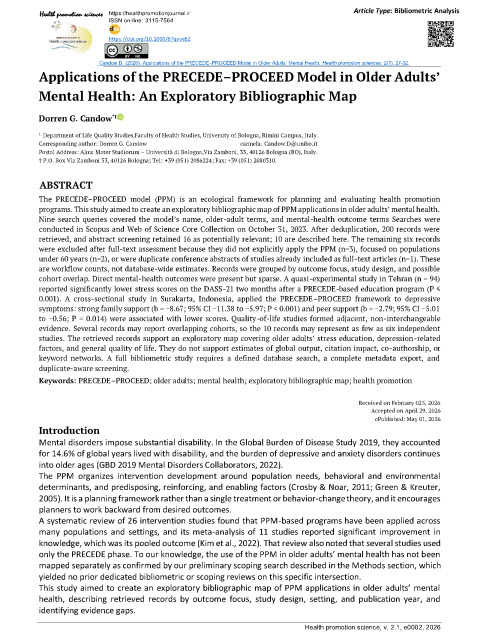
Applications of the PRECEDE–PROCEED Model in Older Adults’ Mental Health: An Exploratory Bibliographic Map
Mapping PRECEDE–PROCEED for Older Adults’ Mental Health
DOI:
https://doi.org/10.1000/67qvve62Abstract
The PRECEDE–PROCEED model (PPM) is an ecological framework for planning and evaluating health promotion programs. This study aimed to create an exploratory bibliographic map of PPM applications in older adults’ mental health. Nine search queries covered the model’s name, older-adult terms, and mental-health outcome terms Searches were conducted in Scopus and Web of Science Core Collection on October 31, 2023. After deduplication, 200 records were retrieved, and abstract screening retained 16 as potentially relevant; 10 are described here. The remaining six records were excluded after full-text assessment because they did not explicitly apply the PPM (n=3), focused on populations under 60 years (n=2), or were duplicate conference abstracts of studies already included as full-text articles (n=1). These are workflow counts, not database-wide estimates. Records were grouped by outcome focus, study design, and possible cohort overlap. Direct mental-health outcomes were present but sparse. A quasi-experimental study in Tehran (n = 94) reported significantly lower stress scores on the DASS-21 two months after a PRECEDE-based education program (P ≤ 0.001). A cross-sectional study in Surakarta, Indonesia, applied the PRECEDE–PROCEED framework to depressive symptoms: strong family support (b = −8.67; 95% CI −11.38 to −5.97; P < 0.001) and peer support (b = −2.79; 95% CI −5.01 to −0.56; P = 0.014) were associated with lower scores. Quality-of-life studies formed adjacent, non-interchangeable evidence. Several records may report overlapping cohorts, so the 10 records may represent as few as six independent studies. The retrieved records support an exploratory map covering older adults’ stress education, depression-related factors, and general quality of life. They do not support estimates of global output, citation impact, co-authorship, or keyword networks. A full bibliometric study requires a defined database search, a complete metadata export, and duplicate-aware screening.
Downloads
References
Afkari, M., Solhi, M., Matin, H., & Afkari, H. (2011). Effectiveness of PRECEDE educational model on enhancement quality of life in elders – members of the Tehran Elderly Cultural Center – 2009. Hayat (Journal of the Faculty of Nursing and Midwifery, Tehran University of Medical Sciences), 17(1), 45–54.
Crosby, R., & Noar, S. M. (2011). What is a planning model? An introduction to PRECEDE-PROCEED. Journal of Public Health Dentistry, 71(Suppl. 1), S7–S15. https://doi.org/10.1111/j.1752-7325.2011.00235.x
Doshmangir, P., Shirzadi, S., Tagdisi, M. H., & Doshmangir, L. (2014). Effect of an educational intervention according to the PRECEDE model to promote elderly quality of life. Journal of Education and Community Health, 1(2), 1–9. https://doi.org/10.20286/jech-01021
GBD 2019 Mental Disorders Collaborators. (2022). Global, regional, and national burden of 12 mental disorders in 204 countries and territories, 1990–2019: A systematic analysis for the Global Burden of Disease Study 2019. The Lancet Psychiatry, 9(2), 137–150. https://doi.org/10.1016/S2215-0366(21)00395-3
Ghaffari, M., Sharifirad, G., Hassanzadeh, A., & Zanjani, S. (2011). Effect of educational intervention based on PRECEDE model on level of stress among elderly referred to health homes of Tehran in 2009. Journal of Health Promotion Management, 1(1), 35–44.
Green, L. W., & Kreuter, M. W. (2005). Health program planning: An educational and ecological approach (4th ed.). McGraw-Hill.
Kim, J., Jang, J., Kim, B., & Lee, K. H. (2022). Effect of the PRECEDE-PROCEED model on health programs: A systematic review and meta-analysis. Systematic Reviews, 11, Article 213. https://doi.org/10.1186/s13643-022-02092-2
Matin, H., Afkari, M., & Taghdisi, M. (2013). The effect of an educational intervention based on the PRECEDE model on quality of life improvement in the elderly affiliated with Tehran Culture House for the Aged – 2009. Health Education and Health Promotion, 1(1), 15–22.
Matin, H., Rastgarimehr, B., Afkari, M., Solhi, M., Taghdisi, M., Mansourian, M., Shafieyan, Z., Mostafa, Q., Asayesh, H., & Jafaraliloo, H. (2014). Relationship between the educational stage of PRECEDE model and quality of life improvement in the elderly affiliated with Tehran Culture House for the Aged. Iranian Journal of Diabetes and Lipid Disorders, 13(6), 469–478.
Mazloomymahmoodabad, S., Masoudy, G., Fallahzadeh, H., & Jalili, Z. (2014). Education based on Precede-Proceed on quality of life in elderly. Global Journal of Health Science, 6(6), 178–184. https://doi.org/10.5539/gjhs.v6n6p178
Sharifirad, G., Ghaffari, M., Zanjani, S., & Hassanzadeh, A. (2013). The effectiveness of educational intervention based on PRECEDE model on the level of stress among the elderly at elderly clubs. Journal of Education and Health Promotion, 2, Article 3. https://doi.org/10.4103/2277-9531.106641
Tunurrohmin, Z. (2020). Application of Precede Proceed model on factors affecting depression symptom in the elderly: Evidence from Surakarta, Central Java. In Proceedings of the 7th International Conference on Public Health (445–452). https://doi.org/10.26911/the7thicph.01.44
Tunurrohmin, Z., Soemanto, R., & Pamungkasari, E. (2019). Path analysis on the determinants of depression symptom in elderly: A PRECEDE PROCEED model. Journal of Epidemiology and Public Health, 4(4), 351–360. https://doi.org/10.26911/jepublichealth.2019.04.04.10
Wang, Q., Dong, L., Jian, Z.-J., & Tang, X.-H. (2017). Effectiveness of a PRECEDE-based education intervention on quality of life in elderly patients with chronic heart failure. BMC Cardiovascular Disorders, 17, Article 262. https://doi.org/10.1186/s12872-017-0698-8
Downloads
Published
Issue
Section
Categories
License
Copyright (c) 2026 Creative Commons Attribution-NonCommercial 4.0 International License

This work is licensed under a Creative Commons Attribution-NonCommercial-NoDerivatives 4.0 International License.
This open-access journal is published under the terms of the Creative Commons Attribution-NonCommercial 4.0 International License which permits Share (copy and redistribute the material in any medium or format) and Adapt (remix, transform, and build upon the material) under the Attribution-NonCommercial term
How to Cite
Share