Predicting Safety Behaviour among Cement workers: application of the PRECEDE-PROCEED model
A Quasi-Experimental Study with Structural Equation Modeling of Stress-Related Determinants of Safety Behavior
DOI:
https://doi.org/10.1000/mg8g5s28Keywords:
Occupational stress, Safety behavior, PRECEDE-PROCEED model, Cement industry, Stress management, Iran.Abstract
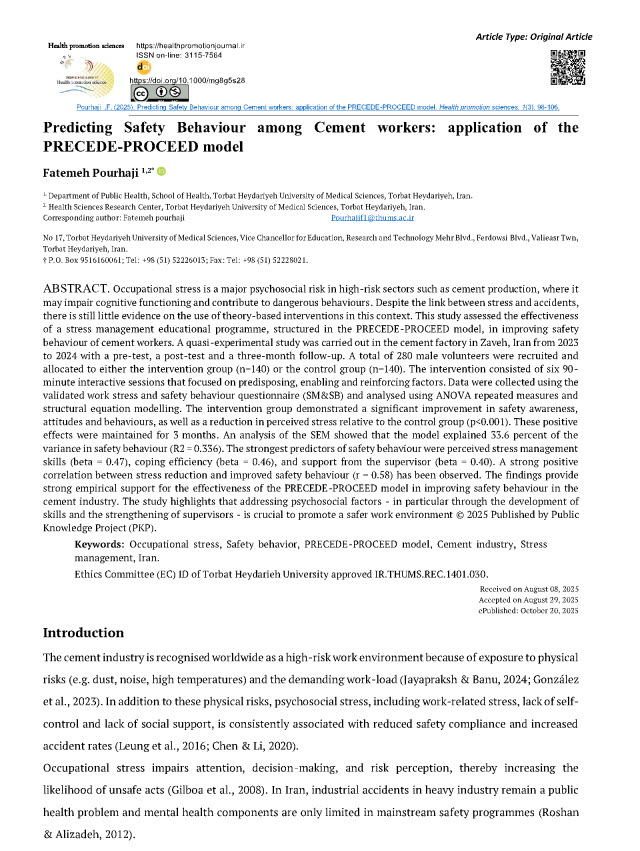
Occupational stress is a major psychosocial risk in high-risk sectors such as cement production, where it may impair cognitive functioning and contribute to dangerous behaviours. Despite the link between stress and accidents, there is still little evidence on the use of theory-based interventions in this context. This study assessed the effectiveness of a stress management educational programme, structured in the PRECEDE-PROCEED model, in improving safety behaviour of cement workers. A quasi-experimental study was carried out in the cement factory in Zaveh, Iran from 2023 to 2024 with a pre-test, a post-test and a three-month follow-up. A total of 280 male volunteers were recruited and allocated to either the intervention group (n=140) or the control group (n=140). The intervention consisted of six 90-minute interactive sessions that focused on predisposing, enabling and reinforcing factors. Data were collected using the validated work stress and safety behaviour questionnaire (SM&SB) and analysed using ANOVA repeated measures and structural equation modelling. The intervention group demonstrated a significant improvement in safety awareness, attitudes and behaviours, as well as a reduction in perceived stress relative to the control group (p<0.001). These positive effects were maintained for 3 months. An analysis of the SEM showed that the model explained 33.6 percent of the variance in safety behaviour (R2 = 0.336). The strongest predictors of safety behaviour were perceived stress management skills (beta = 0.47), coping efficiency (beta = 0.46), and support from the supervisor (beta = 0.40). A strong positive correlation between stress reduction and improved safety behaviour (r = 0.58) has been observed. The findings provide strong empirical support for the effectiveness of the PRECEDE-PROCEED model in improving safety behaviour in the cement industry. The study highlights that addressing psychosocial factors - in particular through the development of skills and the strengthening of supervisors - is crucial to promote a safer work environment
Downloads
References
Bandura, A. (1986). Social foundations of thought and action: A social cognitive theory. Prentice-Hall.
Chen, Y., & Li, S. (2020). Relationship between workplace ostracism and unsafe behaviors: The mediating effect of psychological detachment and emotional exhaustion. Psychological Reports, 123(2), 488–516. https://doi.org/10.1177/0033294119842305
Didehvar, M., Jalili, Z., Zareban, I., Shahrakipour, M., & Bakhshani, N. M. (2015). The effect of stress management education based on PRECEDE model on occupational stress of nurses in hospitals of Iranshahr Iran. Strides in Development of Medical Education, 12(3), 472–484.
Gilboa, S., Shirom, A., Fried, Y., & Cooper, C. (2008). A meta-analysis of work demand stressors and job performance. Personnel Psychology, 61(2), 227–271. https://doi.org/10.1111/j.1744-6570.2008.00113.x
González, S., Romana, F., Gestoso, C., & Santos, A. (2023). Psychosocial factors in the safety level in an industrial process: The case study of a cement producer. Japan Journal of Research, 4, 112–125.
Green, L. W., & Kreuter, M. W. (2005). Health promotion planning: An educational and ecological approach (4th ed.). McGraw-Hill.
Jayapraksh, S., & Banu, D. P. V. (2024). A study on work stress among cement manufacturing workers: An empirical analysis. Educational Administration: Theory and Practice, 30(1), 45–59.
Leung, M.-Y., Liang, Q., & Olomolaiye, P. (2016). Impact of job stressors and stress on the safety behavior and accidents of construction workers. Journal of Management in Engineering, 32(1), 04015019. https://doi.org/10.1061/(ASCE)ME.1943-5479.0000391
Payne, H. E., Wilkinson, J., West, J. H., & Bernhardt, J. M. (2016). A content analysis of PRECEDE-PROCEED constructs in stress management mobile apps. mHealth, 2, 38. https://doi.org/10.21037/mhealth.2016.09.02
Pourhaji, F., Delshad, M. H., Tavafian, S. S., Niknami, S., & Pourhaji, F. (2020). Effects of educational program based on PRECEDE-PROCEED model in promoting low back pain behaviors (EPPLBP) in health care workers: Randomized trial. Heliyon, 6(10), e05236. https://doi.org/10.1016/j.heliyon.2020.e05236
Roshan, S. A., & Alizadeh, S. S. (2012). Estimate of economic costs of accidents at work in Iran: A case study of occupational accidents. Iranian Journal of Public Health, 41(8), 1–10.
Downloads
Published
Issue
Section
Categories
License
Copyright (c) 2025 Creative Commons Attribution-NonCommercial 4.0 International License

This work is licensed under a Creative Commons Attribution-NonCommercial-NoDerivatives 4.0 International License.
This open-access journal is published under the terms of the Creative Commons Attribution-NonCommercial 4.0 International License which permits Share (copy and redistribute the material in any medium or format) and Adapt (remix, transform, and build upon the material) under the Attribution-NonCommercial term
How to Cite
Share




Funding data
-
Torbat Heydariyeh University of Medical Sciences
Grant numbers Grant numbers Research plan number in the university system (research code): 400000001;IRCT: IRCT20160824029512N3,Code of Ethics: IR.THUMS.REC.1401.030;Torbat Heydarieh University approved the study